A cloud of cold atoms
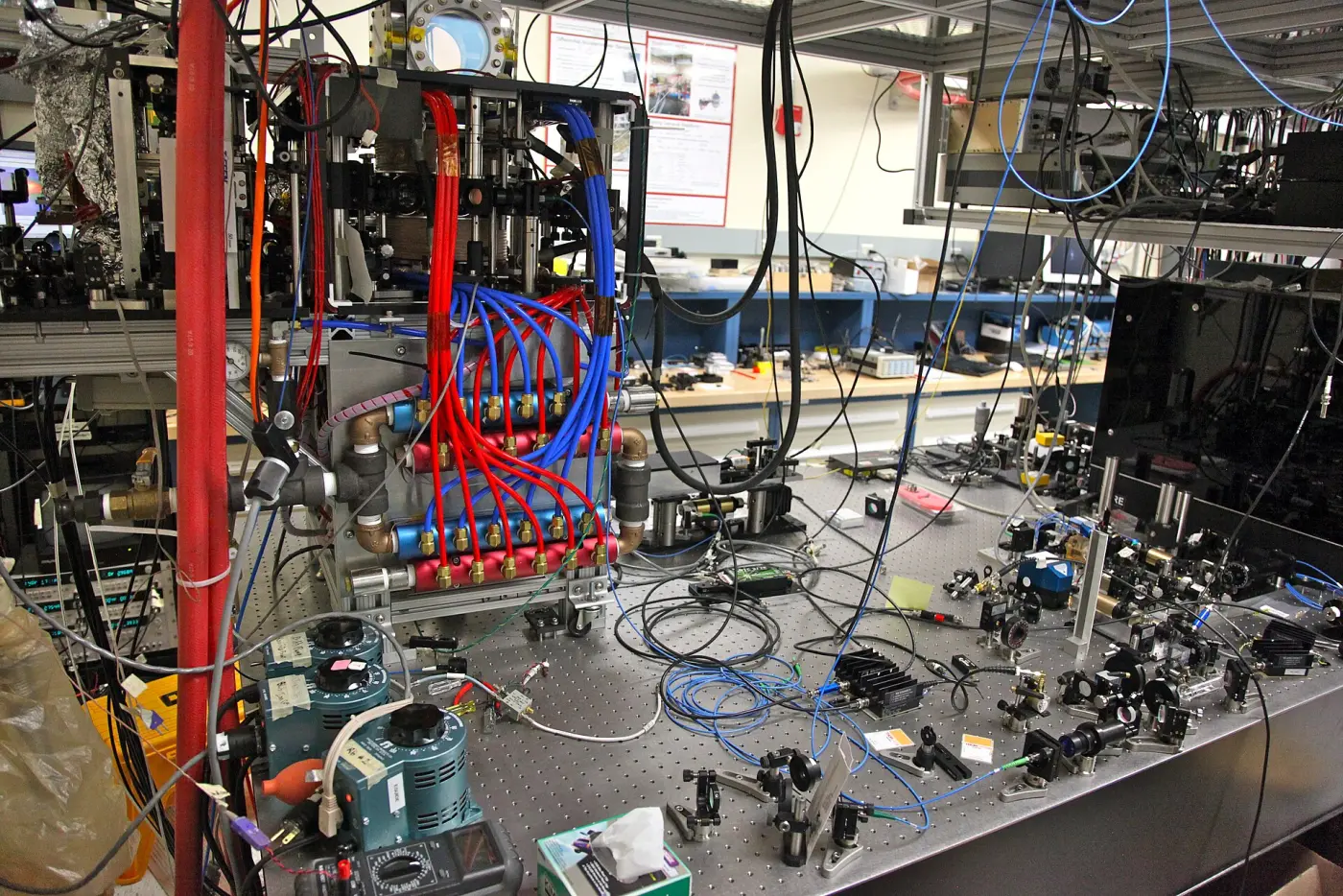
Danish physicist Lene Hau and a Harvard team cooled sodium atoms almost to absolute zero: to mere billionths of a degree above it. This creates a Bose–Einstein condensate, a special state of matter. The team sent light pulses through this cloud of atoms.
Your guess
How fast was a light pulse inside the ultracold atom cloud?
How it works
For this light the atom cloud would normally be opaque. A second laser makes it transparent – a quantum effect. At the same time, the refraction changes very steeply with frequency, and the pulse as a whole crawls: its group velocity drops. Light is also slower in glass or water; it is fastest in a vacuum.
Stopped – and sent on again
In 2001 the team went further: it suddenly switched off the second laser, and the pulse stopped in a cold cloud of sodium. Strictly speaking, its information was then held in the atoms for up to a millisecond. With the laser back on, the pulse returned and moved on. A second Harvard team achieved this independently with rubidium gas.
What it could be good for
The team sees applications in quantum information processing: light carries information, and stopped light can be stored as in a memory and read out again. Later, Hau's team transferred a qubit from light to a matter wave and back into light.