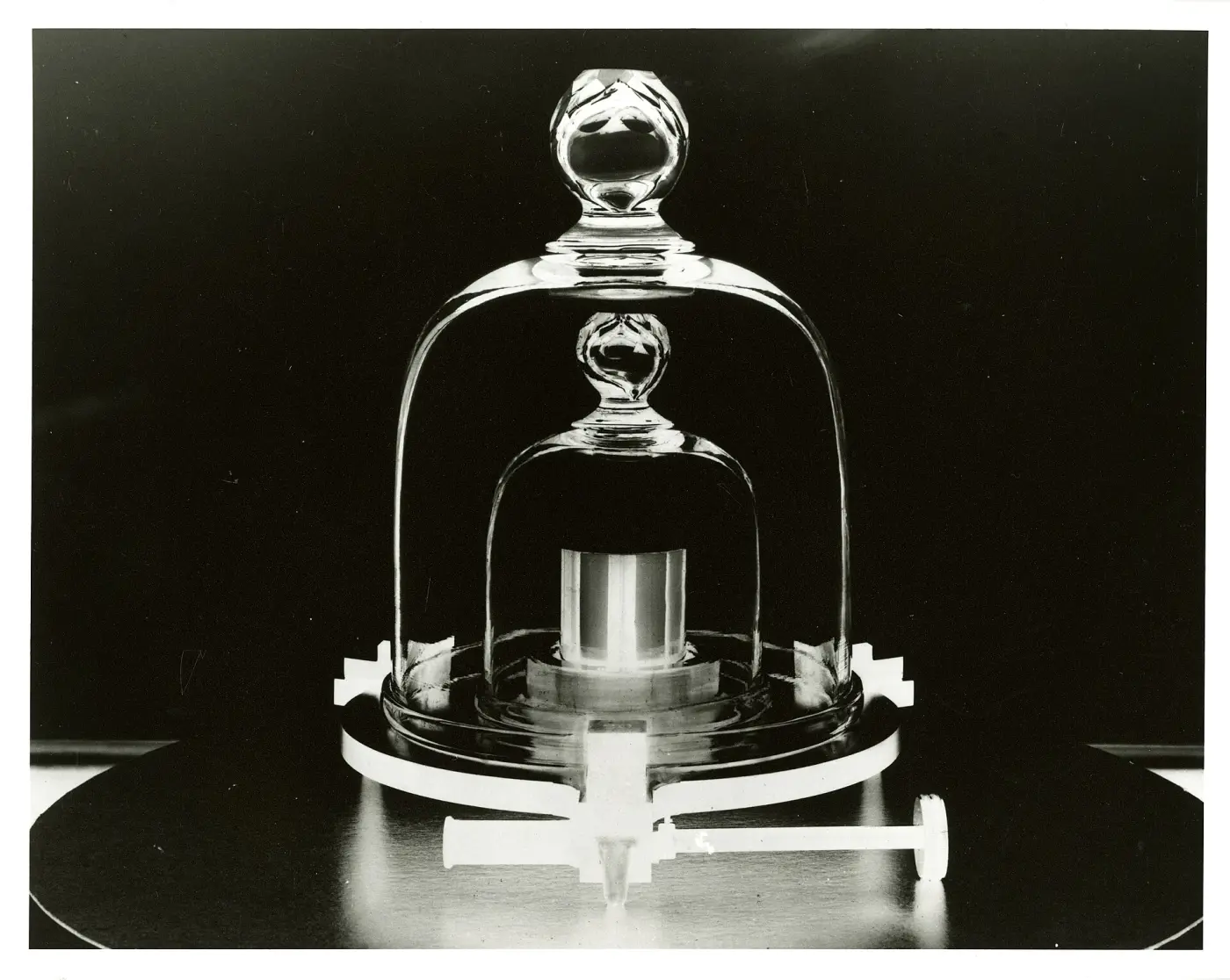

A kilogram you could touch
From 1889 to 2019 the kilogram was the mass of one particular cylinder of platinum and iridium, 39 mm tall and 39 mm wide. It sits under glass bell jars in a vault near Paris. Other countries received official copies as their national standards.
Your guess
Almost every copy gained mass relative to the prototype. What happened?
A fly's wing of difference
50µgaverage gap between the copies and the prototype over about 100 years
On average the difference was about 50 micrograms – roughly the mass of a fly's wing. For science, that is a lot. Then there is dirt: a cleaning removes 5 to 60 micrograms, and new grime starts settling immediately.
The trouble with an object
An object that defines a unit cannot weigh the wrong amount – it is the standard. If it loses atoms, the unit itself changes, and officially all the copies get heavier. So the kilogram was to be tied, like the metre and the second, to a constant of nature that is the same everywhere in the universe.
Since 2019: the Planck constant
Since 20 May 2019, the Planck constant h has been exactly 6.62607015 × 10⁻³⁴ kg·m²/s. Because the metre and the second are already fixed, the kilogram follows. It can be measured, for example, with a Kibble balance, which holds a weight suspended by electromagnetic force – no prototype needed.