A river as a sewer
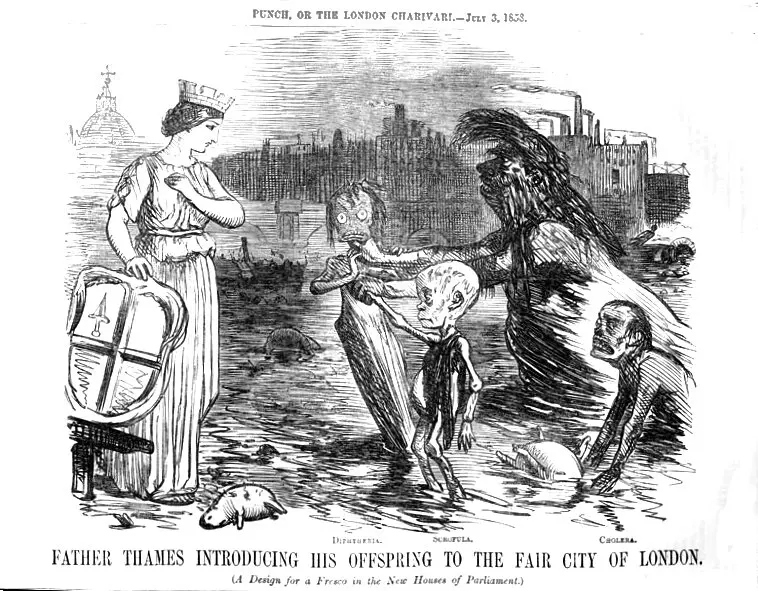
London emptied its sewage into the Thames. In June 1858, temperatures in the shade rose to 34 to 36 degrees, the river ran low, and the sewage stayed on the banks. The press called it "The Great Stink".
Your guess
What did they do in Parliament against the stench?
Handkerchief to the nose
Benjamin Disraeli left a committee room with papers in one hand and his handkerchief pressed to his nose. On 15 July he introduced a bill, and by 2 August it had passed. London was allowed to borrow 3 million pounds to clean up the Thames.
Bazalgette's tunnels
318million brickswent into the new sewer network
The engineer Joseph Bazalgette planned 1,800 kilometres of street sewers feeding into 132 kilometres of main sewers. On a gentle slope they carry the sewage east, away from the city. They were built from 1859 to 1875 – and the system still works today.
Deep dive
Cholera and bad air
In the 19th century most people believed that contagious diseases came from breathing in bad air, so-called miasma – such as the smell of sewage. Cholera was blamed on it too. London suffered severe outbreaks: 6,536 people died in 1831, 14,137 in 1848/49 and another 10,738 in 1853/54. Of all things, the fear of miasma made matters worse: to keep the sewers from smelling, they were regularly flushed through – and even more sewage ended up in the Thames.
Continues in the app
- John Snow and the pump
- The stink as a stroke of luck
- Pumps, cement and new riverbanks
- The last outbreak
- Quiz with 3 questions
- 3 key points to keep