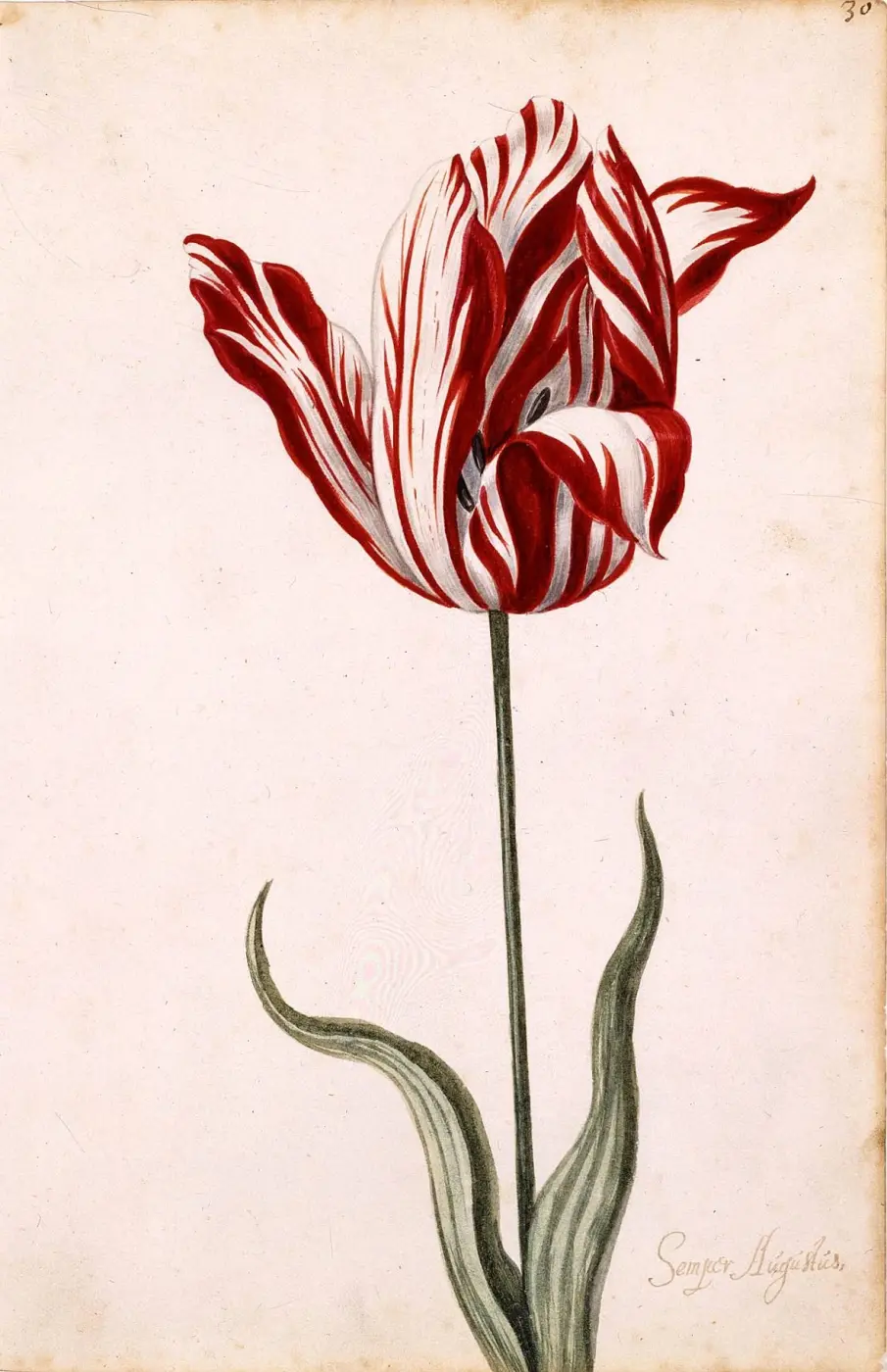
A flower becomes a luxury
10,000guildersfetched by the most expensive tulip, Semper Augustus, at the peak
In February 1637 some tulip bulbs cost more than ten times what a skilled craftsman earned in a year: about 300 guilders. The most expensive tulip, Semper Augustus, even sold for 10,000 guilders.
Your guess
What gave the most expensive tulips their splendid stripes?
Trading in air
Mostly, it wasn't bulbs that changed hands but contracts for future ones. The Dutch called it "windhandel" – trading in air. According to a satire of the time, on 3 February 1637 an auction in Haarlem found no buyers. Soon after, prices collapsed.
The myth of mass ruin
The story became widely known in 1841 through a book by the journalist Charles Mackay: many investors had been ruined, he wrote. For "Tulipmania" (2007), Anne Goldgar examined old contracts. Of the many traders she tracked down, fewer than half a dozen had money troubles – and even there it's unclear whether tulips were the cause.
Deep dive
How the tulip came to Holland
The story often goes that the envoy Ogier de Busbecq sent the first tulip bulbs and seeds from the Ottoman Empire to Vienna in 1554. The botanist Carolus Clusius planted tulips in the imperial garden in Vienna in 1573 and in 1592 finished the first major work on them, including their colour variations. In 1593 he moved to Leiden University and planted his collection in the new Hortus Botanicus. The bulbs coped with the harsher climate of the Low Countries – and the tulip soon became popular.
Continues in the app
- Striped by a virus
- Contracts instead of bulbs
- Contracts become options
- Bubble or not?
- Quiz with 3 questions
- 3 key points to keep