Your guess
According to the New York Times, what did the US Navy expect from the machine in 1958?
Left or right?
50trieswas all the computer needed to learn it
In July 1958 an IBM 704 – five tons, the size of a room – was fed punch cards. Some were marked on the left, some on the right. After 50 runs it could tell them apart on its own. Nobody had programmed the rule into it.
An eye made of 400 cells
400photocellsformed the "retina" of the Mark I Perceptron
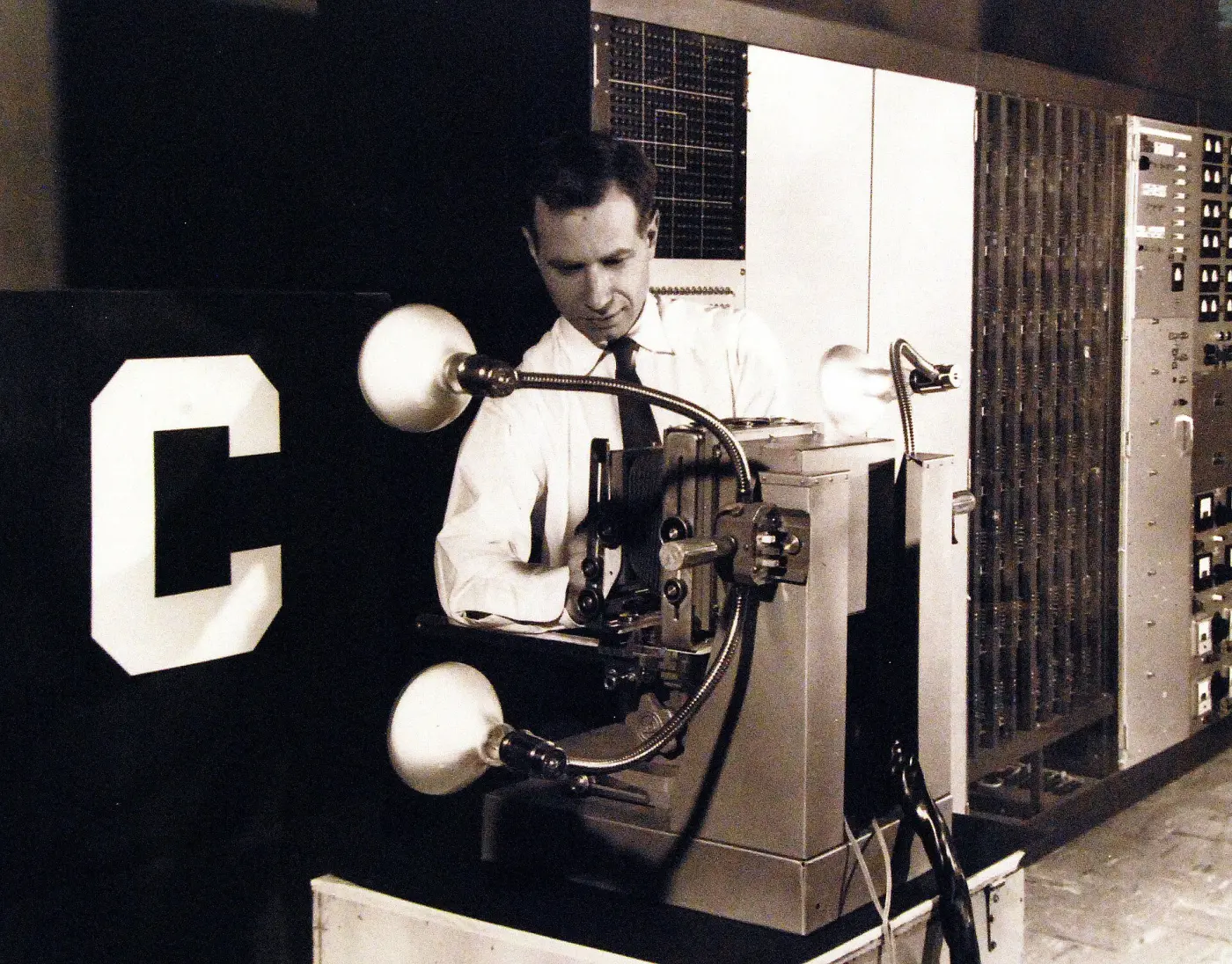
Next, Rosenblatt's team built a machine of its own, the Mark I Perceptron. A camera with 20 × 20 photocells produced a 400-point image. What the machine learned sat in rotary resistors that electric motors adjusted during learning.
The setback
In 1969 Marvin Minsky and Seymour Papert showed in their book "Perceptrons" what such simple networks cannot compute – the XOR function, for example. The book is seen as one reason research turned to other approaches for years. Rosenblatt died in a sailing accident in 1971, on his 43rd birthday.
The idea was right – just too small
Today's neural networks work on the same principle: they give an answer, and if it's wrong, they adjust themselves a little. Rosenblatt would only have had to make it a million times bigger, says Cornell computer scientist Thorsten Joachims.

_(20897323365).jpg)